What Is Carbon Brushes
The carbon brush is a very small industrial component. Although the carbon brush is small, its value is difficult to replace. The carbon brush is one of the essential parts inside various motors. Its main material is carbon material, which has conductive properties and is used to transmit current to components that require rotational movement.
The earliest carbon brush was invented by British scientist Joseph Wilson Swan in 1867. With the development of electric motors and generators, carbon brushes gradually became widely used.
At the end of the 19th century and the beginning of the 20th century, carbon brushes were used in various applications. In a variety of industrial and household appliances, the use of carbon brushes allows these devices to transmit current and achieve electrical energy conversion and mechanical movement.

Carbon Brush Components
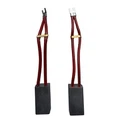
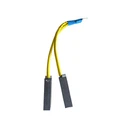
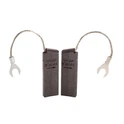
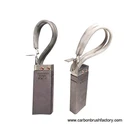
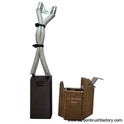
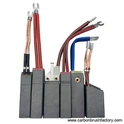
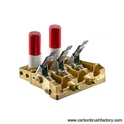
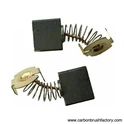
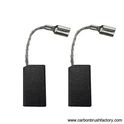
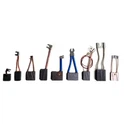
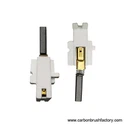
The composition of carbon brushes is not fixed. Some are just a bare carbon brush, some are carbon brushes and wires, some are carbon brushes,wires,connectors, some are carbon brushes,wires,springs,metal connectors, and some are carbon brushes,metal brush holders/plastic Brush holder. But its core part is the carbon brush head, which is mostly presented in a square shape.

How Do Carbon Brushes Work
The working principle of carbon brushes is mainly by transmitting energy or signals between the fixed part and the rotating part of rotating machinery such as motors or generators.
The carbon brush is to add external current (excitation current) to the rotating rotor through the carbon brush (input current); to introduce the static charge on the large shaft into the earth through the carbon brush (grounding carbon brush) (output current); to The large shaft (ground) is led to the protection device for grounding protection of the rotor and measuring the positive and negative voltages of the rotor to ground; changing the direction of the current (in commutator motors, the brushes also play a commutation role).

Carbon Brush Grade Types

Natural Graphite
Natural graphite is the main raw material of this type of carbon brush. The binder is made of asphalt or resin, which is baked or sintered at 1000 degrees. This type of motor has good lubrication performance and current collection performance. Most of them are used in collector rings of small and medium-sized DC motors and high-speed turbine generators that run smoothly.

Metallic Graphite
The main materials of this type of carbon brush are electrolytic copper and graphite. Depending on the needs, other metals such as silver powder (used in precision instruments and very expensive), aluminum powder, lead powder, etc. are sometimes used. it is suitable for low-voltage motors with high load and low commutation requirements (such as car starter motors, etc.).

Electrochemical Graphite
The main components are various carbon powder materials such as carbon black, coke and graphite, which are converted into microcrystalline artificial graphite after high temperature treatment at 2500 degrees. This type of carbon brush has excellent commutation and self-lubricating properties, and is widely used in various AC and DC motors.
Carbon Brush Application
Carbon brushes are used in various motors and generators, such as industrial generators: wind and thermal generators; home appliances: washing machines, vacuum cleaners, wall breakers, and motors on massage chairs. A variety of hardware tools, and all motors on cars, forklifts, and motorcycles. Carbon brushes exist in every aspect of our lives, so it can be seen that carbon brushes are quite important.


What Is The Function Of Carbon Brush?
Carbon brushes play a key role in brushed DC motors. The primary function of carbon brushes is to transmit current. When the brushed DC motor is powered on, the current enters the stator from the power supply and is transmitted to the coil on the rotor through the carbon brushes. The carbon brushes Contact with the rotating rotor introduces current into the coil, thereby generating a magnetic field, which interacts with the magnetic field of the stator to push the rotor to rotate.
And the carbon brush also has the function of improving sparks. Sparks and arcs may be generated due to the transmission and disconnection of current. The various graphite materials used in the carbon brushes have good electrical conductivity and wear resistance, which can effectively reduce sparks and arcs in the motor.


When to Replace Carbon Brush?
When replacing carbon brushes, factors such as wear, length, and shape need to be considered. As the use time of the motor increases, the friction between the carbon brush and the rotor will cause a certain degree of wear of the carbon brush. The wear of the carbon brush will affect the performance and stability of the motor.
Generally speaking, when the carbon brush appears: It should be replaced when:
1. Severe wear (less than 1/3 of the original length);
2. Severe damage;
3. The contact surface between the carbon brush and the slip ring is less than 70%, so the carbon brush should be replaced with a new one. If the length of the carbon brush If it is too short, the rotor may not be accessible, which will cause the current to not flow smoothly and affect the normal operation of the motor.
In addition, if the carbon brush is broken or deformed, poor contact will occur, and the carbon brush needs to be replaced with a new one. Different application scenarios and frequency of use will affect the frequency of carbon brush replacement. If the current is unstable or abnormal noise occurs during use of the equipment, it may also be a signal to replace the carbon brush.