


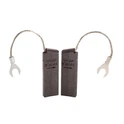
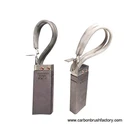
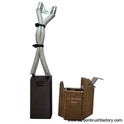
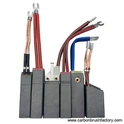
A carbon brush is a component used to conduct electrical current between the stationary and rotating parts of a motor. In a generator or motor, the commutator rotates on a shaft and the fixed carbon brush rides on it to permit the flow of electricity and complete a circuit.Originally, brushes were made of wire and looked like standard wire brushes. However, the wire brushes tended to wear away the commutator and suffered other run-time issues. The introduction of graphite provided brushes that allowed a more uniform shift of current between commutator segments. Graphite carbon brushes also wear, sparing the commutator. Moreover, the inclusion of special additives in the graphite can help lubricate the connection and the graphite is generally tailored to suit specific operational needs.
Why Choose Us
Quality Control
The factory adheres to the principle of quality first and has a strict quality control and quality inspection system to ensure that every product meets standards and requirements.
Main products
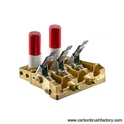
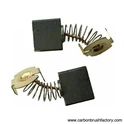
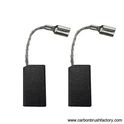
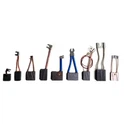
Mainly produces: Power tool carbon brushes (makita, bosch, dewalt, hilti etc), household appliance carbon brushes (washing machines, vacuum cleaners, coffee machines, wall breakers etc), industrial carbon brushes (wind turbines, thermal generators, train traction machines etc)
Rich experience
Carbonpro industry llc was established in 1998 and has 25 years of experience in carbon brush production, focusing on manufacturing high-quality products and providing first-class services.
Professional team
With advanced production equipment and technical team, it adopts efficient production processes and is committed to maintaining environmental friendliness and reducing environmental impact through sustainable production methods.


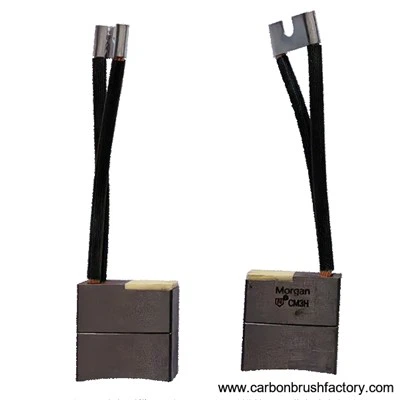
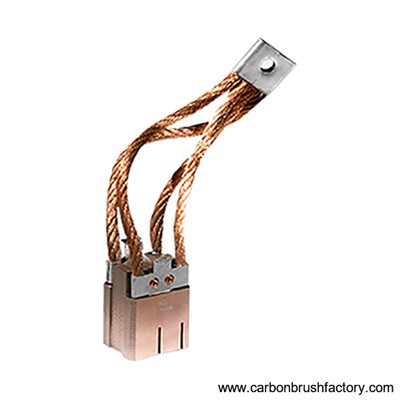
Product Categories
Latest Products
Benefits of Industry Carbon Brush
Low Friction and Wear
Carbon brushes exhibit low friction levels due to the self-lubricating properties of carbon. This characteristic reduces wear and tear on both the brushes and the contacting surfaces, leading to longer lifespan and less frequent maintenance requirements.
Good Conductivity
Carbon is an excellent conductor of electricity, ensuring efficient and consistent current transfer between moving and stationary parts. This high conductivity minimizes power loss, heat generation, and voltage drops, enhancing overall device performance.
Thermal Resistance
Carbon brushes can withstand elevated temperatures generated during operation, making them suitable for applications involving high-speed and high-friction environments. Their ability to handle heat contributes to the durability and reliability of devices utilizing carbon brushes.
Versatility
Carbon brushes can be customized to fit various applications. Manufacturers can modify the composition, shape, and size of the brushes to optimize their performance in different devices and operating conditions, allowing for adaptability and versatility.
Cost-Effectiveness
Carbon brushes are relatively affordable to produce, making them cost-effective choices for industries requiring large quantities of electrical devices. Their affordability makes them a popular option for manufacturers aiming to balance performance and budget considerations.
Application of Industry Carbon Brush
Electric Motors
Carbon brushes are widely used in electric motors, including DC motors, AC motors, and universal motors. They make contact with the commutator (in DC motors) or slip rings (in AC motors) to deliver electrical current to the rotor windings, allowing the motor to operate.
Generators
Carbon brushes are also used in generators to provide electrical contact between the rotor windings and the stationary part of the generator (stator). This allows the generator to produce electrical power as the rotor rotates within the stator.
Alternators
Alternators, which are used in automotive applications to generate electrical power for charging the battery and powering electrical systems, also use carbon brushes to make contact with the slip rings on the rotor.
Power Tools
Many power tools, such as drills, grinders, and saws, use electric motors with carbon brushes. The brushes make contact with the commutator or slip rings to deliver electrical power to the motor, enabling the tool to perform its intended function.
Industrial Equipment
Carbon brushes are used in various industrial equipment, including pumps, compressors, fans, and conveyors, that rely on electric motors to operate. The brushes provide the necessary electrical contact between the stationary and rotating parts of the machinery.
Railway Traction Motors
Carbon brushes are employed in railway traction motors, which are used to propel trains. The brushes make contact with the commutator or slip rings to deliver electrical power to the motor, allowing the train to move.
Industrial Carbon Brush Grade Selection


Carbon Graphite
Carbon graphite brushes for electrical motors are among the oldest carbon brush types. They are made of high strength material, but are generally limited to lower current densities on older, slower speed machines. High friction with this type of material makes it unsuitable for present day use on commutators.
Electrographitic Carbon Brushes
Strength and density distinguish electrographitic carbon motor brushes. This is due to the makeup of raw materials that go into making these brushes. The outcome is superior commutating ability, performance at high temperature/low humidity settings and as a result, longer life. Treatments can allow electrographitic materials to operate well in a variety of contaminated environments.
Graphite Carbon Brushes
Graphite brushes are layered with graphite bonded with resin to form a layered brush material. Their controlled filming and excellent riding qualities on both commutators and slip rings characterize these graphite brushes. The fast filming properties of graphite brushes is beneficial in protecting the commutator or slip ring during operation in contaminated atmospheres. Their low absorption and higher density are valuable in reducing commutator threading found in contaminated environments.
Metal Graphite Carbon Brushes
Metal graphite carbon brushes for electrical motors are often made from natural graphite and fine metal powders. Copper is the most common, but silver, tin and lead are sometimes used. Metal graphite brushes are ideal for many applications due to low resistivity. Metal graphite brushes are used on commutators of plating generators that have low voltage and high brush current densities. They operate on rings of wound rotor induction motors where high brush current densities are also found. Metal graphite brushes are used with grounding brushes because of their low contact drop.
How to Choose Industry Carbon Brush
Assessing Quality and Reliability
Evaluate the quality of carbon brushes offered by suppliers. Look for suppliers who provide high-quality carbon brushes made from durable materials to ensure longevity and optimal performance.Research the supplier's reputation for reliability. Check reviews, testimonials, or ask for recommendations to gauge their reliability in delivering quality products consistently.Ensure that the supplier adheres to industry standards and regulations. Suppliers who follow standards like ISO certifications often maintain quality and reliability in their products and services.
Product Variety and Customization Options
Look for a supplier that offers a diverse range of carbon brushes. A supplier with various options can cater to different industries, applications, and specific needs, providing you with more choices.Consider suppliers that offer customization options. Custom-made carbon brushes tailored to your specific requirements can enhance efficiency and performance in your equipment or machinery.Check if the supplier provides complementary accessories or services such as holders, springs, or technical support. Having access to these additional items can be beneficial for your equipment maintenance needs.
Pricing and Cost-effectiveness
Compare prices from different suppliers to ensure competitive rates. However, be cautious of extremely low prices as they may compromise the quality of the carbon brushes.Consider the total cost beyond the initial purchase. Factor in aspects like durability, performance, and maintenance requirements. A slightly higher upfront cost might be justified by the long-term performance and longevity of the carbon brushes.Look for suppliers that offer a balance between quality and cost-effectiveness. Choosing a supplier that provides value for money ensures you get reliable products without overspending.
Customer Support and Service
Assess the supplier's customer service responsiveness. A supplier who is attentive to inquiries, provides technical support, and addresses concerns promptly can be crucial in ensuring a smooth purchasing experience.Consider the supplier's delivery times and lead times for orders. Timely delivery of carbon brushes when you need them is essential to avoid disruptions in your operations.Inquire about after-sales support and warranty policies. Suppliers offering warranties or post-purchase assistance demonstrate confidence in their products and commitment to customer satisfaction.
How Do You Make Industry Carbon Brush?
Creating the Carbon Block-The Right Material is Key
The first step in the process is to make the block of carbon, that this batch of brushes will be cut from.The block is a combination of materials, specifically designed to a resistance that matches the voltage and wattage of the power tool they're going to be used in.Power tool brushes will typically use a carbon-graphite mix, but other materials used can be copper graphite, silver graphite, natural graphite, and electro graphite.
Design the Carbon Brush & Cut to Size
The carbon brush has to be designed to fit a specific power tool, and so you need to ensure it meets the exact dimensions of the carbon brush holder it's going into.This involves making the drawings and cutting it to the exact size.
Grind the Brush Body Until Smooth
It's important to have a consistent contact point, so the brush must be grinded until it has smooth edges.
Measure the Brush Body to Check Specs
This is a final precuation to ensure the brush still meets the specification. A negative tolerance between -0.1mm and 0mm is acceptable.
Make a Hole in the Carbon and Embed the Wire
To create the connection to the static part of the tool, we need to embed a wire within the carbon brush, so at this stage we drill a hole into the carbon brush and add the conductive wire.
Weld the Wire to the Terminal
Finally we need to weld the terminal to the end of the wire, to ensure it can properly connect to the power tool system.Some brushes not only have just a wire and an end terminal (like a push on spade connector), but also have a spring design which needs to have the right tension, length, diameter and thickness, to ensure the carbon brush has the right pressure against the Commutator. So the spring design part of a carbon brush must also be considered when making the final product.

Regular cleaning
Power tools produce dust and debris during use, which can get between the carbon brush and the brush contact surface, causing the carbon brush to wear out too quickly. Regular cleaning can reduce wear and tear on the carbon brushes, and it is recommended to clean the power tool housing and internal parts after each use. When cleaning, the machine should be disassembled first, each part should be cleaned with a soft brush, and then wiped clean with a clean rag.
Regular inspection
Regularly check whether the carbon brushes wear out too quickly, it is recommended to check them every three months, and replace them in time if necessary.
Correct installation
When replacing the carbon brush, you should pay attention to the direction and position of the installation to ensure the correct installation and avoid damaging the power tools.
Avoid overload operation
Overload operation will lead to an increase in heat in the power tool motor, which in turn will accelerate the wear and tear of the carbon brush, resulting in power tool failure.
What Are The Main Precautions in The Installation Process Of Industry Carbon Brush?
If the lead wire of the carbon brush is sleeved with an insulating pipe, it should be installed in the insulated carbon brush holder; The lead wire is a bare copper wire and should be installed in a carbon brush holder.
When the carbon brush is loaded into the carbon brush holder, attention should be paid to the direction of the curved surface, and the contact surface will be too small, and the power generation will be weak or not generated.
The carbon brush should be able to rise and fall freely in the carbon brush holder, and if there is a card phenomenon, the excess part should be grinded off.
The carbon brush spring should be pressed in the center of the carbon brush to prevent eccentric wear due to uneven force.
The contact area between the carbon brush and the commutator should not be less than 3/4 of the total contact surface, and the carbon brush should not have oil stains.
Our Factory
Carbonpro industry llc is a factory specializing in the production of motor carbon brushes. Mainly produces: power tool carbon brushes (Makita, Bosch, Dewalt, Hilti etc), household appliance carbon brushes (washing machines, vacuum cleaners, coffee machines, wall breakers etc), industrial carbon brushes (wind turbines, thermal generators, train traction machines etc), automotive carbon brushes, forklift carbon brushes, small motor carbon brushes, silver carbon brushes, and carbon brush holders for carbon brushes. CARBONPRO INDUSTRY LLC has established a sound management system with integrity, efficiency and performance as its core competitiveness, and provides customers with world-class services as its strategic goal by focusing on innovation, improving quality, timely delivery, rapid response and cost control. We hope to create greater value for more customers through our unremitting efforts.


FAQ
Q: How often do carbon brushes need replacing?
How often do carbon brushes need replacing? Carbon brushes generally last between one and five years. The exact amount of time it takes for carbon brushes to wear down depends on the tool in question, how often that tool is used and how many hours the tool has been in operation.
Q: What are the disadvantages of carbon brushes?
Q: How do I know if carbon brushes need replacing the washing machine?
Q: Why do carbon brushes wear out quickly?
Q: Why do carbon brushes wear unevenly?
Q: Do new carbon brushes spark?
Q: Do carbon brushes need to bed in?
Q: What are the alternatives to carbon brushes?
Q: Do carbon brushes get hot?
Q: Why is my washing machine noisy after new carbon brushes fitted?
Q: What is the life of carbon brush?
Q: What is the problem with carbon brushes in washing machines?
Q: Can you grind down carbon brushes?
Q: Is it normal for carbon brushes to spark?
Q: How do you inspect carbon brushes?
Q: What is the difference between AC and DC carbon brush?
Q: What is the code for carbon brushes?
Carbon Electrodes, Carbon Brushes, Lamp Carbons, Battery Carbons And Other Articles Of Graphite Or Other Carbon Used For Electrical Purposes.
Q: Do carbon brushes get hot?
Q: Do carbon brushes need to bed in?
Q: Why do carbon brushes wear unevenly?
We're professional industry carbon brush manufacturers and suppliers in China, specialized in providing high quality customized service. We warmly welcome you to buy industry carbon brush in stock here from our factory. For price consultation, contact us.
Bosch GWS 6 100 Carbon Brush, forklift carbon brush, Makita CB440 Carbon Brushes