At a time when renewable energy is developing rapidly around the world, wind power generation has become an important part of green energy. However, wind turbines will be affected by mechanical friction, electrical loss and other issues during long-term operation. Among them, the quality and performance of carbon brushes are directly related to the overall efficiency of wind turbines. Although carbon brushes are small, they are an indispensable component in wind power generation systems.
What is a carbon brush?
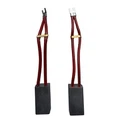
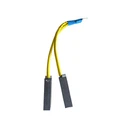
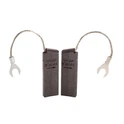
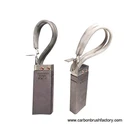
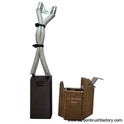
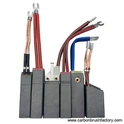
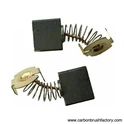
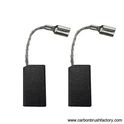
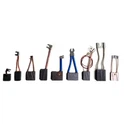
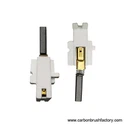
A carbon brush is an electrical contact element made of graphite or metallic graphite material, mainly used to transfer current from the fixed part to the rotating part of the motor, generator, slip ring or commutator.
As the name suggests, the core material of the carbon brush is carbon, which has excellent conductivity, good self-lubrication, high temperature resistance, uniform wear and is not easy to damage the matching parts (such as slip rings or commutators)
● Stable conduction of current or signal
● Reduce electric sparks and electrical noise
● Improve the overall reliability of the generator or pitch system
Although it is small in size, the quality and design of the carbon brush are directly related to the stability, maintenance cost and service life of the power generation equipment, and it is one of the indispensable key components of wind turbines.

The role of carbon brushes in wind turbines
In modern wind turbines, carbon brushes are mainly used in slip ring assemblies, pitch systems and yaw motors, responsible for conducting current from rotating parts (such as rotors) to fixed parts.
● Slip ring assemblies: conduct excitation current to rotor windings
● Variation system: adjust blade angles to optimize wind energy capture and prevent overspeed
● Yaw motor: keep the nacelle aligned with the wind direction
Although these functions seem to be only supporting roles, they directly determine:
● Real-time power regulation
● Safety protection in strong winds or sudden weather
● Power generation efficiency and long-term economic benefits
If high-quality carbon brushes are missing or in poor condition, electrical contact will be unstable, causing current fluctuations, reduced efficiency, and even causing wind turbine shutdown or expensive emergency repairs.

How to use carbon brushes to improve wind power generation efficiency
If you want to truly improve wind power generation efficiency through carbon brushes, accurate selection is an important factor. It not only affects the life of the carbon brush itself, but also directly determines the degree of wear of the slip ring, the efficiency of the generator and the stability of the whole machine.
Matching materials according to the power and current density of the unit
High-power wind turbines (such as ≥5 MW) need to withstand higher excitation currents and heat loads. Commonly used metal graphite carbon brushes have better conductivity and heat dissipation performance because of their high copper content; for medium and low power or relatively stable current models, resin-bonded graphite carbon brushes can be used first to balance conductivity and wear performance.
Considering wind farm environmental factors
● Offshore wind farms: Salt spray is highly corrosive and humidity is high, and carbon brushes need to have good corrosion resistance and hydrophobicity; it is recommended to choose carbon brushes that have been specially impregnated, such as resin or metal salts.
● Deserts, plateaus or severe cold areas: Pay attention to the carbon brushes' resistance to high and low temperature impact and dust, as well as their ability to maintain stable conductivity at low temperatures.
Matching slip ring materials and structures
Different materials (copper alloy, steel) and structures (integral or segmented slip rings) have different contact characteristics.
● Copper alloy slip rings: Good conductivity, but relatively soft, more prone to wear due to over-hard carbon brushes; slightly softer carbon brush materials should be selected.
● Steel slip rings: High hardness, but slightly poor conductivity; can be equipped with carbon brushes with higher copper content to supplement the conductivity.
Customized requirements
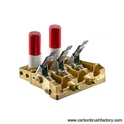
Some large or special models! (such as variable pitch direct drive units) require customized carbon brush size, shape or special brush box structure to ensure better heat dissipation or easy installation and maintenance.
Maintenance and replacement strategy for carbon brushes in wind turbines
Although carbon brushes are small components in wind turbines, they are the core bridge connecting the rotating part and the fixed part. Any wear, poor contact or arcing problems may directly affect the power generation efficiency and safety of the unit. Therefore, a scientific maintenance and replacement strategy is particularly critical.
Regular inspection and record keeping
It is recommended to conduct a comprehensive inspection every 6-12 months, and dynamically adjust the cycle according to the unit's operating environment, power size and slip ring wear. Focus on the length of the carbon brush, wear uniformity, contact surface flatness, and whether there are traces of ablation and arcing.
Condition monitoring and predictive maintenance
The modern wind power industry is gradually adopting intelligent sensors to monitor the wear speed, current fluctuations and temperature changes of carbon brushes in real time. Combined with the big data analysis of the SCADA system (supervision and data acquisition system), potential faults can be predicted in advance and sudden downtime can be reduced.
Reasonable replacement and slip ring maintenance
When replacing, use high-performance carbon brushes that match the model and environment, and polish the slip ring or clean the surface simultaneously to ensure that the new carbon brush can have stable contact and reduce initial wear.
Establishing operation and maintenance standards and training
Develop detailed carbon brush operation and maintenance procedures and checklists, and regularly train operation and maintenance personnel to unify replacement standards and operating methods to reduce abnormal wear or failure caused by human factors. Through systematic maintenance and replacement strategies, wind farms can not only extend the service life of carbon brushes and slip rings, but also significantly reduce operation and maintenance costs, and improve overall power generation reliability and economic benefits.
Conclusion
Wind turbine carbon brushes play a vital role in the operating efficiency of wind turbines. Reasonable selection of carbon brushes can effectively improve the stability and economic benefits of wind power systems. If you need to improve the stability of wind power projects and reduce operating costs, you can contact us. We focus on providing high-quality industrial carbon brushes to help the wind power industry achieve more efficient and lower-cost operations. Make your equipment more efficient and sustainable!
Wind Turbine Carbon Brush Products